and occasionally rides a bike.
A word of warning. The walk descriptions are not detailed enough to guide you - please take a map. The batteries never run out, and you always have a signal. Oh, And don't take left or right as gospel!

Showing posts with label Crowland. Show all posts

Wednesday, April 22, 2015

Welland - Crowland to Cowbit


Tuesday 21 April 2015

With Marta. Along Welland then road, return via bridleway and minor roads. Sunny and quite warm! Alas, no pub in Cowbit. More like 10.5 miles, I think, according to the map and my internal mile counter.

Crowland greeted us with thatched animals - a(nother) cat . . .


a large bird - possibly a cormorant

and then not quite an animal but a cup and saucer on the roof of the Old Copper Kettle tea shop.  This tempted us to start the day with a coffee and toasted teacake in comfort. 

We took the car just out of the town so that we could start our walk along the Brown Fen Waterway trail along the right bank of the Welland.
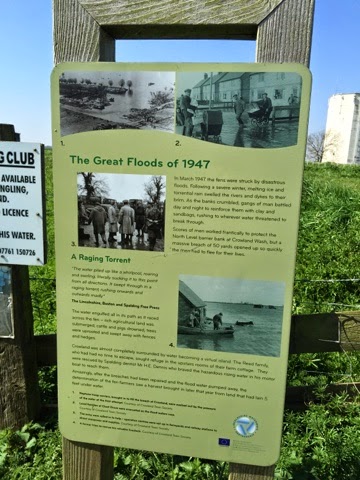
Just before we joined the path was this notice giving information about the enormous floods caused when the snow melted after the severe winter of 1947.
Walking occupied most of my attention, as the path was quite uneven underfoot, and the wind was against us. A couple of miles of this proved quite demanding, though we saw great crested grebes, mallards, swans, not to mention a couple of deer which had trapped themselves on the wrong side of the fence near the river. One leapt over, and we can only hope the other joined it.  Just as we left the river bank we saw swallows flying around a small sluice gate. We followed a path to the right, crossed a drain via a footbridge and reached a small quiet road halfway between Cloot House Farm and Brotherhouse (Toll) Bar. 
At the junction with a busier road is St Guthlac's Cross, an old boundary marker for the estate of Crowland Abbey. We couldn't decipher the inscription, but according to Wikipedia it said "Hanc Petra Guthlac" - This is Guthlac's stone.  It dates from around 1200.  the plinth is modern, as the stone has been moved from its original position.


We took the road to the right, scorning the bridleways marked on the map, thinking they could be tricky walking. The road wasn't too bad - just a tad too busy to be pleasant.
It took us to a few houses with the  unlikely name of Peak Hill, before finally reaching Cowbit  - pronounced Cubbit, according to the village website.

Unfortunately for us the village pub was demolished some time ago, so we feasted on cereal bars and our flasks of coffee. It felt like the back of beyond, but is only four miles from Spalding, and is on the bus route from Spalding to Peterborough, via Crowland. Were we tempted? Not seriously, since the weather was so fine, and now we knew we were shortening the distance left with every step.
Cowbit Church - St Mary's.
For the return leg we took the bridleway parallel to the road, over Cowbit Wash, as far as Brotherhouse Bar, then we walked along the quiet road, with a few school run cars at this time. We caught sight of a small muntjac peering out from a field of rape.  The road turned left at a right angle at Cloot House, carried on past Little Lodge Farm, twisting to the right then the left and eventually brought us into Crowland, not far from the Abbey. 

A walk which seemed longer than it was took us through the town and out along the Gravel Causeway to the car. Further than we've walked for a while - probably a whisker over ten miles.

Thursday, February 5, 2015

Crowland

We decided to spend most of today exploring the town of Crowland - a place which used to be one of the many islands in the fens. This meant that our walk was short - five miles, maybe. It was cold too.
The Welland valley covered in last night's snow

Tixover church

The approach to Crowland
Crowland is a place I am more used to seeing in hot weather, sometimes after a sweaty cycle ride through the fens, but today was very different.

Triangular Bridge
The bridge used to span the two rivers which met in the town.  Before the fens were drained the main streets of Crowland were waterways. There was originally a wooden bridge, but this structure was probably built in the fourteenth century.

Not Cromwell, may be Christ, or may be an abbot

Thatch cat


The Abbey
There are some excellent self-guide sheets available, both for the present church and the outside area, which used to be a very large abbey. It was dissolved by Henry VIII in 1539 and also suffered a siege in the Civil War, when Cromwell's forces defeated the local Royalists and the abbey was destroyed in 1643.
On the rood screen - St Guthlac arriving at Crowland in his boat
Guthlac was a Saxon noble and warrior who later became religious and a hermit, arriving at this isolated island ( with a servant or two) to spend his life in contemplation and prayer. For more details see this blog.
An unusual aggressive green man
Other curious items in the abbey include a heart casket, in which hearts of those killed in the crusades were kept and the skull of Abbot Theodore, who was slain by Viking invaders while he was praying. The skull is kept in the abbey, but locked away since it was stolen in 1982, but returned 17 years later with a note of apology. 
'As a callow youth, I stole the skull and as a responsible adult, I return it!'
The fifteenth century parish chest is a hefty affair with three locks. Three people had one key each, so that no one person could unlock it.


Halley's comet - the hairy star, apparently seen by the stonemasons.
 It was cold even inside the abbey, and it was essential to warm up before we walked anywhere, so off to the Copper Kettle tearoom we went. The warm fire and friendly company worked wonders.  
We took the track towards Peakirk, following this as far as Kennulph's stone. According to Heritage Gateway, this is the story:
After a succession of lawsuits about the possessions of Crowland Abbey in the marshes, and the appointing, in 1389, of a commission to enquire into the marking of boundaries, new stone crosses were erected at Kenulfston and elsewhere. In 1394 men of Deeping destroyed the cross and were imprisoned in Lincoln Castle, where they remained till their friends set up another cross at Kenulfston. A modern block of stone with date 1817 has been erected on the old base, which stands on the banks of the Welland. 
Kennulph was the first abbot of Crowland in 716.
Kennulph's stone
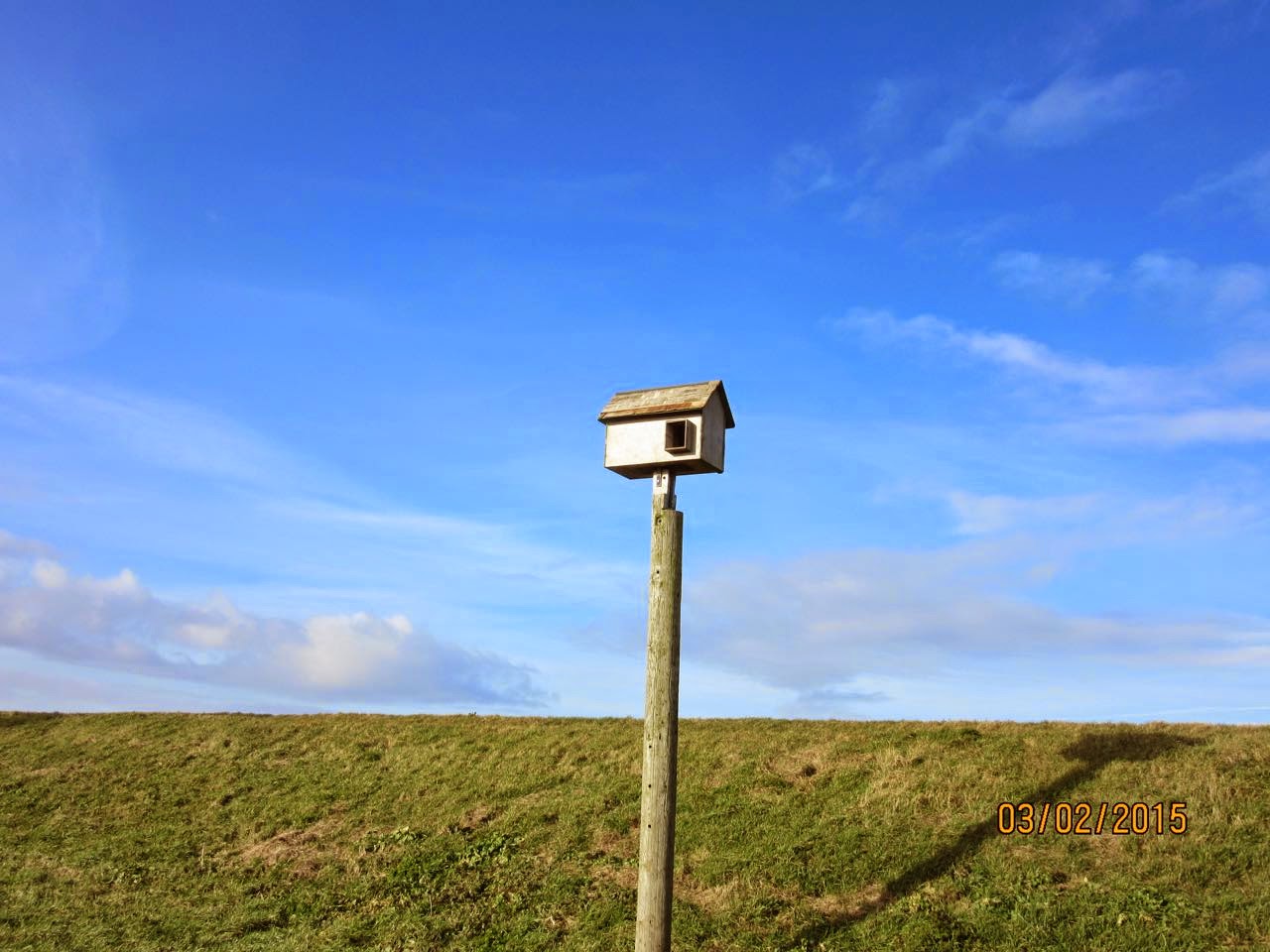
A bird box - not sure what for though
We returned via a path nearer to the river, through a field with a rather importunate pony. We were glad to shut the gate on this one, and turned right parallel to the road from Fen Bridge. Not a day for many people to be sitting on the benches, and five minutes was long enough for us!